
Are your preschool dance exercises developmentally-appropriate?
It’s amazing to live in a time when we can hop on Instagram or TikTok and get fresh ideas for our dance classes in an instant.
But not all preschool dance exercises are created equal.
This is where dance teacher training and discernment really come into play.
Dance teachers and dance studio owners need the knowledge and skills to be able to select developmentally-appropriate content and resources for their dance classes.
Let’s take a look at an example of a preschool ballet exercise that looks like it’s scaffolding ballet technique for younger dancers, but actually inhibits the development of foundational ballet and dance technique.
Teaching turnout takes a turn for the worse.
You might have seen an exercise like this doing the rounds a while ago 👉🏽
Preschool dancers walking “turned out” on yoga blocks.
Here’s why dance exercises like this miss the mark.
The exercise set up and use of props puts intentions in the wrong place.
The focus is on turnout, when it should be on posture, weight transfer, and balance.
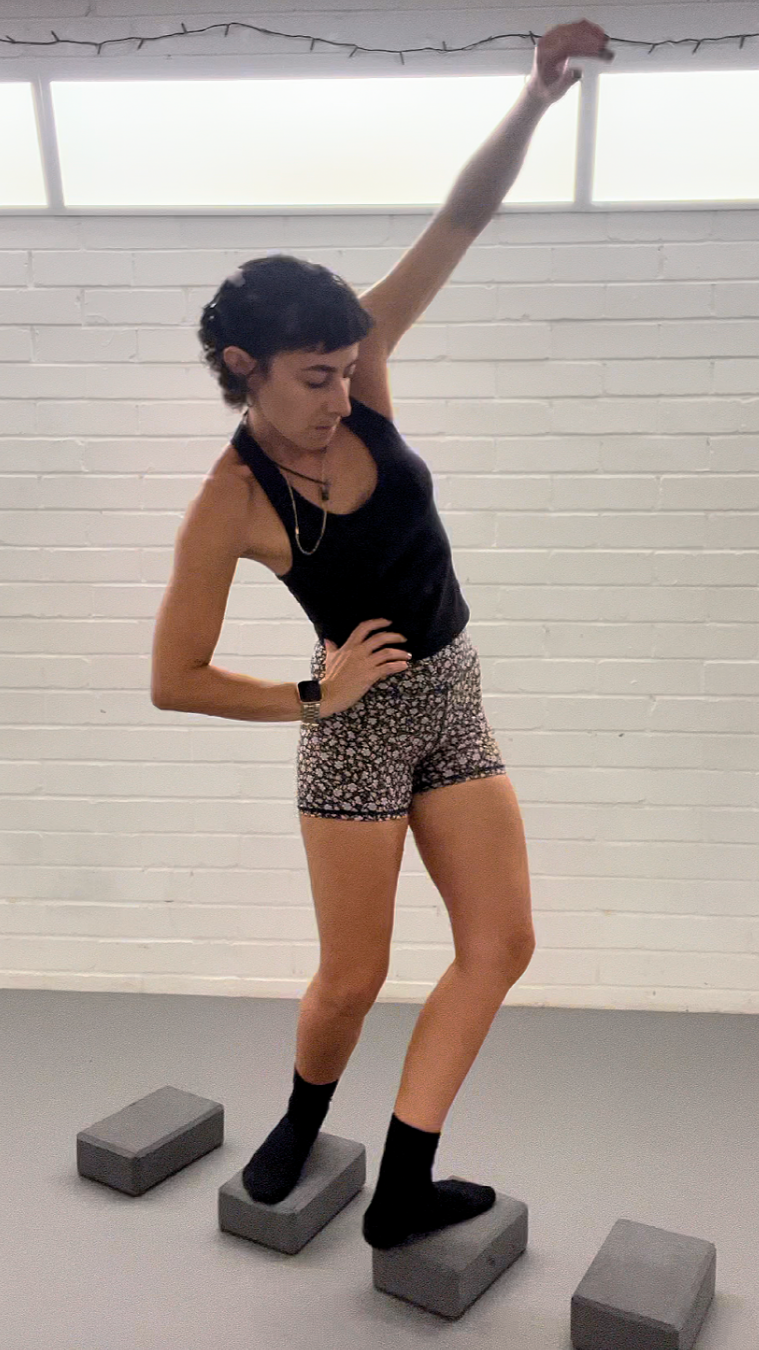
When demands are too high in one area, sacrifices have to be made in others…
In order to meet the wildly advanced technical demands (literally 180° turnout!? 😫) something has to give... and it does.
I’ve seen footage of young dancers doing this exercise and it’s the same every time:
⚠️ their knees bend because that's the only way they can achieve the required foot placement on the block
⚠️ they send their hips backwards and shoulders come forward
⚠️ their eyes and head are permanently cast downwards because they're so focused on where their next foot is going to go
⚠️ their arms lose control because they're fighting for their life to just stay somewhat upright
⚠️ and, ironically, they're not actually learning to activate their turnout correctly.
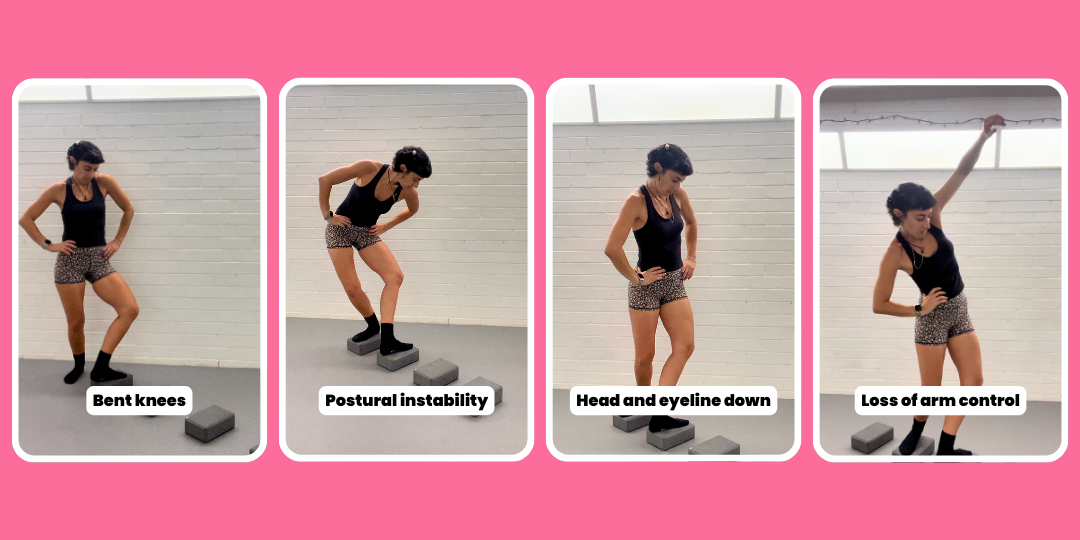
When an exercise exceeds an appropriate level of demand, the body finds ways to compensate in order to ‘achieve’ the task.
Are you teaching the finished product, or the process?
Finis Jhung puts it more clearly than I ever could:
“You either stand or fall - whenever you fall, you’re not dancing - you must get on your leg!”
This exercise does NOT teach students how to be on their leg.
It jumps the gun.
It's all about the end point – turned out classical walks – and not the process of how we get students there.
It might sound obvious, but young dancers need to start at the start… and, actually, this goes for beginners of any age.
Fluff-and-filler content isn’t serving your dancers.
Exercises like these are gimmicks.
They give the illusion of scaffolding ballet skills when in reality they ignore or obscure the foundational skills required for secure technique.
They often fail to consider how the selection and use of resources (like props, music, etc) can either support skill development and knowledge-building, or detract from it.
Put simply, the resources we choose and how we use them matters, evidenced here by the choice to place the yoga blocks horizontally and spaced apart (keep reading for how I would change this to make the exercise more developmentally appropriate for early childhood dance classes 👀👇🏽)
In the case of this exercise, the pursuit of teaching turnout is prioritised over the skills that children actually need to learn in order to be able to perform classical walks with precision and control in later years.
❇️ Can they stand?
❇️ Can they maintain their posture?
❇️ Can they move their body through space with control?
This is what should be taught in dance classes for 3-6 year olds.
There's no rush.
And actually, by 'going slow', we're giving our students the best chance of success 🐢🏆
An age-appropriate approach to prepare young ballet dancers for classical walks
So, how could this exercise be modified to be more developmentally-appropriate for preschool dancers?
I actually like the yoga blocks.
They provide sensory input, an added balance challenge, and a little novelty which can go a long way with young learners.
But I’d change how they’re being used, and this is what I’d do:
👉🏽 line the blocks up vertically in one line, end-to-end with no gaps in between. This reduces the need for children to be looking downwards to figure out where their next foot will be placed. Yes, they still need to see where the block is, but not as much as horizontal blocks spaced apart. (If my yoga blocks were lightweight, I’d also use sticky matting underneath to minimise any shifting or movement as they’re being used. This increases safety and reduces the need for adjustments mid-exercise)
👉🏽 get students to walk heel-to-toe in parallel with hands on hips (or arms outstretched) keeping their posture upright
👉🏽 once students have worked on this and consolidated those skills, try variations, such as:
demi-pointe walks in parallel (tiptoe walks)
pause halfway down the line and balance on one leg in retiré for a count or two and then continue before balancing on the other leg at the end of the line.
toe heel walks in parallel (this is really tricky and can take a long, long time to master)
try holding arms in different positions (e.g. demi-seconde holding a ribbon ring in each hand)
Do you sense a common theme? It’s those four oh-so-wise words from Leap ‘N Learn founder, Beverly Spell:
“Ballet begins in parallel”
But before I got the blocks out, I’d start with good old-fashioned walking on a line. It could be a rollout line (I love this one from Hart Sports in Australia – it’s nicely weighted and doesn’t shift around) or painter’s tape which comes in lots of colours, peels off easily, and doesn’t leave sticky residue on dance floors.
I want to make sure dancers are confident transferring their weight from one leg to another and maintaining their balance and posture before adding more complexity and demands with yoga blocks.
As teachers, we make thousands of micro-choices everyday…
I’m a big fan of sharing knowledge, strategies and ideas, but it’s important that teachers and studio owners understand the developmental needs of their students, select appropriate content, and know how to adapt it to their classes.
So the next time you see something on social media that looks fun, pause for a moment and ask yourself:
Is this developmentally-appropriate? Does it develop foundational skills, or is it jumping ahead?
Does it align with the learning aims for this class, or is it just filling time?
Does it intentionally use props and resources? Do they add meaning to the learning objectives?
Our choices directly impact student learning, outcomes, and wellbeing.
If you want to kill time with filler content, that’s a choice.
If you want to develop skills by meeting children where they’re at, then gradually guiding them towards an end point, that’s a choice.
What do you choose?
(PS: If you’re ever unsure, you can DM me on Instagram @leapnlearn – I’d be happy to help clarify whether an exercise is suitable for a particular class or to meet a desired learning outcome)
👋🏽 Want training and support to make your classes more developmentally appropriate?
👀 Check out our online dance teacher training workshops here.